

Consortium as a whole
The MITHRIL consortium comprises 8 partners from 6 EU countries: Italy, Greece, Poland, Spain, Hungary, and Belgium with a balanced mix of partner roles, from coordination (RINA-CSM) to pipeline producers (CPW), from coating developers (RINA-CSM, FSH, SIC, UNICA) to characterisation and testing centres (RINA-CSM, TEK, Ł-GIT, UGENT, UNICA), from modelling partners (UGENT) to weld developers (SIC, RINA-CSM). Some partners play multiple roles, due to their background, also allowing to reduce the remote risk of one partner dropping out of the Consortium. The inter-disciplinarity of the partners is granted by the presence of academic institutions (UGENT, UNICA), R&D centres (FSH, RINA-CSM, TEK), and industrial partners (CPW).

RINA, through its Centro Sviluppo Materiali (RINA-CSM), is the Coordinator of the MITHRIL project and plays a key role in both the technical development and the overall management of the initiative. RINA-CSM is a significant research center having a recognized role within the international R&D centers for materials and related production technologies. RINA-CSM brings extensive experience in materials engineering, surface technologies, mechanical testing, and full-scale validation, supporting the development of reliable solutions for hydrogen transport infrastructures. RINA-CSM’s activities cover the entire cycle of innovation from basic to applied research (physical, chemical and mechanical properties, new alloys and innovative coatings) to design, engineering, processing (on pilot, demonstration and industrial scales), prototype production, process/system automation and control.

RINA-CSM activities are related to:
-
the development and optimisation of hydrogen permeation barrier coatings for pipeline steels, with a specific focus on pack cementation and sol-gel based coatings. These technologies are investigated to produce dense and adherent barrier layers capable of reducing hydrogen ingress while remaining compatible with industrial manufacturing processes,
-
welded joints, which represent critical areas for hydrogen-induced degradation. RINA-CSM contributes to the assessment of coating behaviour in welded zones and to the evaluation of coating integrity after welding, helping to ensure that the developed solutions are applicable to real pipeline systems,
-
Slow Strain Rate Testing (SSRT) aimed at evaluating the susceptibility of coated and uncoated steels to hydrogen-assisted cracking. These tests provide essential data to compare coating solutions and to support the selection of the most effective technologies,
-
the full-scale characterisation and validation of the most promising coating solutions. This activity bridges the gap between laboratory-scale research and industrial application.

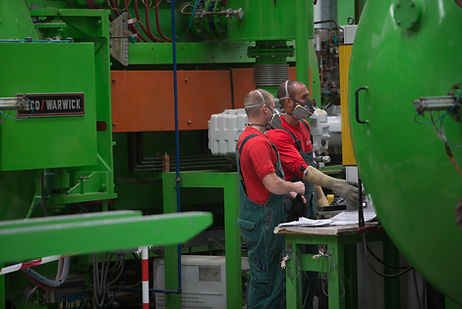
Within the framework of the Mithril project, Flame Spray Hungary (FSH) is actively engaged in the critical processes of selection, fine-tuning, and industrial scale-up of Aluminide diffusion coatings. To achieve the project’s ambitious surface engineering goals, FSH leverages its proprietary GEL/pack aluminizing technology. This innovative approach allows for precise application and enhanced performance, ensuring the coatings meet the rigorous demands of next-generation industrial components.
FSH brings extensive research and development experience to the consortium, having successfully participated in numerous European projects. Notably, this includes the recent Biofire initiative, during which the effectiveness and reliability of their coating technology were rigorously validated. Flame Spray Hungary operates as a strategic subsidiary of the Flame Spray Group (www.flamespray.org), a global leader in the production of thermal spray coatings. This affiliation ensures that the Mithril project benefits from a deep reservoir of industrial expertise, cutting-edge facilities, and a global vision for technological advancement.

Sieć Badawcza Łukasiewicz – Górnośląski Instytut Technologiczny is one of the characterization centres involved in the MITHRIL project and will act as the leader of WP6 Transferability.
The investigation methods used at Łukasiewicz – GIT enable comprehensive characterization of both substrate and coatings as well as analysis of the results obtained for the experimental materials. The investigations will be carried out using an Empyrean X-ray diffractometer by PANalytical, high-resolution scanning electron microscopes—JEOL JSM-7200F and Inspect F—equipped with EDS and EBSD detectors. The diffractometer allows phase identification of inorganic compounds based on PDF-4+ database, quantitative phase analysis using the Rietveld method, and precise measurement of lattice constants. The microscopes are equipped with SE, BSE, EDS, WDS, and EBSD detectors. The EDS and WDS detectors enable precise analysis of the chemical composition in micro-regions. Processing of data obtained using the EBSD detector allows detailed analysis of the crystallographic structure.
As part of WP6, tests in a nuclear hydrogen–relevant environment will be carried out using a universal metallurgical process simulator. The resistance of both the matrix material and the coating systems to the detrimental effects of hydrogen will be assessed based on physical experiments conducted at Ł-GIT. The investigation will be performed in a dedicated system installed on a Gleeble 3800 simulator, enabling hydrogen charging of samples from a high-pressure gas atmosphere. The tests can be carried out over a wide temperature range, from 20°C to 1100°C, under controlled temperature and load/strain conditions.
Sieć Badawcza Łukasiewicz – Górnośląski Instytut Technologiczny, headquartered in Gliwice, Poland, conducts advanced scientific and research activities in the development of metallic materials—particularly steels—and in the formulation of manufacturing technologies for metallic products. The Institute possesses comprehensive laboratory and instrumental infrastructure encompassing design supported by numerical simulations, material synthesis and processing technologies, as well as the simulation of operational and service conditions. The outcomes of these research activities are systematically implemented in industrial practice. The developed solutions are utilized across multiple sectors, including pipeline systems, defense, energy, automotive, aerospace, and space industries.


TEKNIKER (www.tekniker.es) is a Basque technological centre that brings proven experience in materials characterization in hydrogen atmosphere and sustainability to the consortium, having successfully participated in numerous European projects, some of them on topics similar to those of the MITHRIL project. TEKNIKER has its own laboratory for the development of hydrogen technologies and has developed its own Smart and Sustainable Industry Model called Tekniker SustaINDustry to help companies identify key issues related to achieving economic, social and environmental sustainability.
Within the framework of the MITHRIL project, Fundación TEKNIKER (TEK), is actively engaged in conducting electrochemical permeation tests for ranking of coatings, in performing slow strain rate tensile tests (SSRT) in hydrogen for upscaling and in analysing the sustainability of upscaled coatings. To achieve the project’s ambitious goals, TEK leverages its great experience in characterization of materials exposed to hydrogen environment and sustainability aspects in terms of LCA, LCC and S-LCA, contributing in this way to the achievement of the ambitious objectives of MITHRIL.

The Sustainable Materials Science group forms part of the Department of Materials, Textiles and Chemical Engineering (MaTCh) at the Faculty of Engineering and Architecture at Ghent University and is located in the Tech Lane Ghent Science Park, a hub for advanced research and high-tech industry. The research line on environmental assisted degradation (SMS-EAD) has internationally recognized expertise in hydrogen–metal interactions and corrosion processes. Its research strategy combines extensive experimental facilities with modelling capabilities, enabling in-depth studies of hydrogen embrittlement and environmentally induced degradation of metals. The group participates in numerous European and regional projects, as well as bilateral research with our valued industry partners. Renowned for developing innovative experimental methodologies that advance the state-of-the-art, SMS delivers high-impact scientific output and provides research and service support to industrial and academic partners across Europe.
Within the MITHRIL project, Ghent University’s Sustainable Materials Science (SMS) group will perform a thorough hydrogen characterization to evaluate the performance of hydrogen permeation barrier (HPB) coatings and substrate materials under hydrogen exposure. The research will include microstructural characterization, hydrogen permeation and hydrogen uptake determination. Advanced surface and cross-sectional examinations will be performed using microscopy to detect potential hydrogen-induced damage or interfacial degradation. The SMS group will also carry out in-situ hydrogen permeation measurements under mechanical load using a modified Devanathan–Stachurski cell equipped with an external loading device, allowing the evaluation of the diffusion barrier performance in the presence of stress. Hydrogen characterization complemented with microstructural characterization allows to obtain the fundamental understanding of the substrate/coating's performance in terms of impeding or slowing down the hydrogen uptake.
The Laboratory Soete (LS) is part of the Department of Electromechanical, Systems and Metal Engineering (EMSME) at the Faculty of Engineering and Architecture of Ghent University, located at the Tech Lane Ghent Science Park. The laboratory focuses on advanced experimental testing and numerical modelling to investigate fatigue, fracture, reliability, and durability of machine components, pipeline infrastructure, and mechanical structures under service-representative conditions. A central research focus is hydrogen embrittlement, addressed through dedicated mechanical testing in hydrogen environments and computational validation via advanced numerical simulations, enabling a direct link between observed degradation mechanisms and predictive modelling. With internationally recognized expertise in structural integrity and environmentally assisted degradation, LS is actively involved in European and industrial projects and collaborates closely with key stakeholders in the energy and infrastructure sectors, contributing to innovative testing methodologies and simulation-driven solutions for reliable material and component performance.
Within the MITHRIL project, LS will deploy a validated, fully coupled hydrogen diffusion–damage modelling framework to assess hydrogen-assisted degradation in coated pipeline steels. The framework captures the interaction between hydrogen transport and material degradation under mechanical loading, while explicitly representing coating layers to evaluate their effectiveness as hydrogen permeation barriers and their impact on hydrogen uptake and structural integrity. Acting as a virtual lab, this approach supports the interpretation of experimental results and enables efficient, service-representative evaluation of coating–material systems, contributing to the development of safer and more reliable hydrogen transport infrastructure.

The University of Cagliari (UNICA) was founded in 1620 and has a long history in education and research. Today, the University is divided into 6 Faculties and 15 Departments, according to an organisation dedicated to achieving the University’s primary objectives: research, teaching, and the third mission, at the service of the innovation required by today’s knowledge society. Today, about 25’000 students get their education in 49 bachelor’s and 43 master’s courses. With more than 24’750 enrolled students, 47 bachelor’s degrees, 38 master’s degrees, 34 graduate schools, 16 doctoral courses, and five active masters, the University of Cagliari assures an important contribution to the advanced formation of the young people who choose to study in the Sardinian capital, as well as for the entire Island community. Our group “Surface Analysis, Electrochemistry and Corrosion” at the Department of Chemical and Geological Sciences at UNICA has a long and documented track record in national and international research projects. In recent years, it has been involved in projects on low-carbon technologies, green hydrogen, and new materials for hydrogen-permeation barriers.

The research group “Surface Analysis, Electrochemistry and Corrosion” at the department of Chemical and Geological Sciences of the University of Cagliari (UNICA - Superfici), as a partner of the MITHRIL project, will use its specific knowledge and expertise in electrochemistry and XPS surface analysis for the study of electroless Ni–P coatings as barriers to hydrogen permeation. In a first phase, the experiments will be carried out in the laboratory on flat steel samples coated with Ni–P, determining the coating’s porosity and characterizing the surface by X-ray photoelectron spectroscopy (XPS) to support coating optimization. Such analysis can be performed (to a limited extent) also on other selected coatings produced by project partners. In a second phase, electrochemical hydrogen permeation tests will be performed in the modified Devanathan-Stachurski cell. UNICA is the leader of WP3, specifically for the ranking of coatings via permeation tests.


l Sentiero International Campus is an Industrial Research Centre created to support companies in the development of advanced, sustainable, and efficient technologies and products. We operate as a strategic partner for companies aiming to transform technological innovation into growth opportunities, providing expertise, infrastructure, and vision to address market challenges. It operates in strategic industrial sectors where applied research and advanced experimentation are essential to generating sustainable innovation. Our strength also lies in our network of scientific and industrial collaborations, which enables us to offer companies validated, scalable solutions aligned with the highest standards.
Il Sentiero International Campus is an initiative by Ecor International, a company based in Schio (Vicenza) and a strategic partner to produce critical metal components and complex systems. The Industrial Research Centre was established in 2018 with the understanding that innovation is the result of integrating applied research and manufacturing.

Corinth Pipeworks (CPW), steel pipe segment of Cenergy Holdings, is a leading steel pipe manufacturer for the global energy and construction sector. With projects executed in more than 50 countries worldwide, we develop valuable solutions, exceed our customers’ expectations whether the application is a challenging offshore subsea flow line, a high criticality onshore gas transmission pipeline, transportation of 100% hydrogen at high pressures through large diameter/high strength steel pipelines, or a specialized structural steel requirement. All this by combining experience, on time delivery, innovation, and investments in the latest technology.
CPW brings industrial pipeline expertise, materials, and fabrication capabilities to validate hydrogen permeation barrier (HPB) coatings under real-world conditions.
Leading WP2 – Definition & Design, CPW defines steel grades, geometries, coatings, welding, and test parameters while supplying and characterizing base materials.
In WP4 – Upscaling, CPW ensures industrial feasibility of coatings, and in WP5 – Validation (TRL5), it manufactures full-scale pipe mock-ups for testing. CPW also supports WP7 – Weldability, providing specimens and guiding welding qualification.
By bridging research and industrial practice, CPW ensures all coatings are fully compatible with production-ready steels and hydrogen-ready pipeline infrastructure.